Operating Systems | نظم التشغيل | Operating System Concepts
عن الكورس
نظم التشغيل: شرح بالعربي لكتاب Operating System Concepts لكل الجامعات
كورس نظم التشغيل Operating Systems بالعربي لطلاب علوم الحاسب وهندسة الحاسب وتقنية المعلومات في أي جامعة، على كتاب Operating System Concepts لـ Silberschatz, Galvin & Gagne. فيه شرح 10 فصول من المقدمة لحد أنظمة الملفات، ومعاه 3 كويزات وامتحانات ميد وفاينل محلولة. يقدّم الشرح م. عماد مهدي.
في الكورس
- حوالي 140 درس شرح على 10 فصول.
- 3 كويزات على الفصول 1 و2 و3 Dr. Sarah Al-Raddadi.
- تجميعات كويزات في 5 دروس.
- امتحانات ميد محلولة: Midterm 1، Midterm 2، Midterm Fall 2017، Midterm first term 2023.
- امتحانات فاينل محلولة: Final Term Exam, Fall 2021, 42-43، Final Term Exam, Spring 2022, 42-43 (تقنية المعلومات)، Final Exam Fall 2024, 1446.
الفصول
الفصل 1 مقدمة Introduction، الفصل 2 بنية نظام التشغيل Operating-System Structures، الفصل 3 العمليات Processes، الفصل 4 الثريدز Threads، الفصل 5 تزامن العمليات Process Synchronization، الفصل 6 جدولة المعالج CPU Scheduling، الفصل 7 الجمود Deadlocks، الفصل 8 الذاكرة الرئيسية Main Memory، الفصل 9 الذاكرة الافتراضية Virtual Memory، الفصل 10 واجهة نظام الملفات File-System Interface.
أسئلة شائعة
الكورس ده لجامعة معينة؟
لأ، ده كورس عام ينفع لأي جامعة بتدرّس من كتاب Operating System Concepts. ترتيب الفصول ممكن يختلف عندك، فقارنه بتوصيف المادة.
الشرح بالعربي؟
أيوه، الشرح بالعربي، والمصطلحات والمسائل بالإنجليزي زي الكتاب بالظبط علشان متتلخبطش في الامتحان.
فيه امتحانات سابقة محلولة؟
أيوه، فيه 4 امتحانات ميد و3 امتحانات فاينل محلولة، آخرهم Final Exam Fall 2024, 1446.
فيه كويزات أتدرب عليها؟
أيوه، فيه 3 كويزات على أول 3 فصول، وكمان تجميعات كويزات.
مين اللي بيشرح الكورس؟
م. عماد مهدي.
كورس نظم التشغيل العام – Operating Systems
كورس شامل في نظم التشغيل مناسب لطلاب علوم الحاسب، هندسة الحاسب، تقنية المعلومات والتخصصات القريبة في مختلف الجامعات، وليس مرتبطًا بجامعة أو توصيف مقرر بعينه.
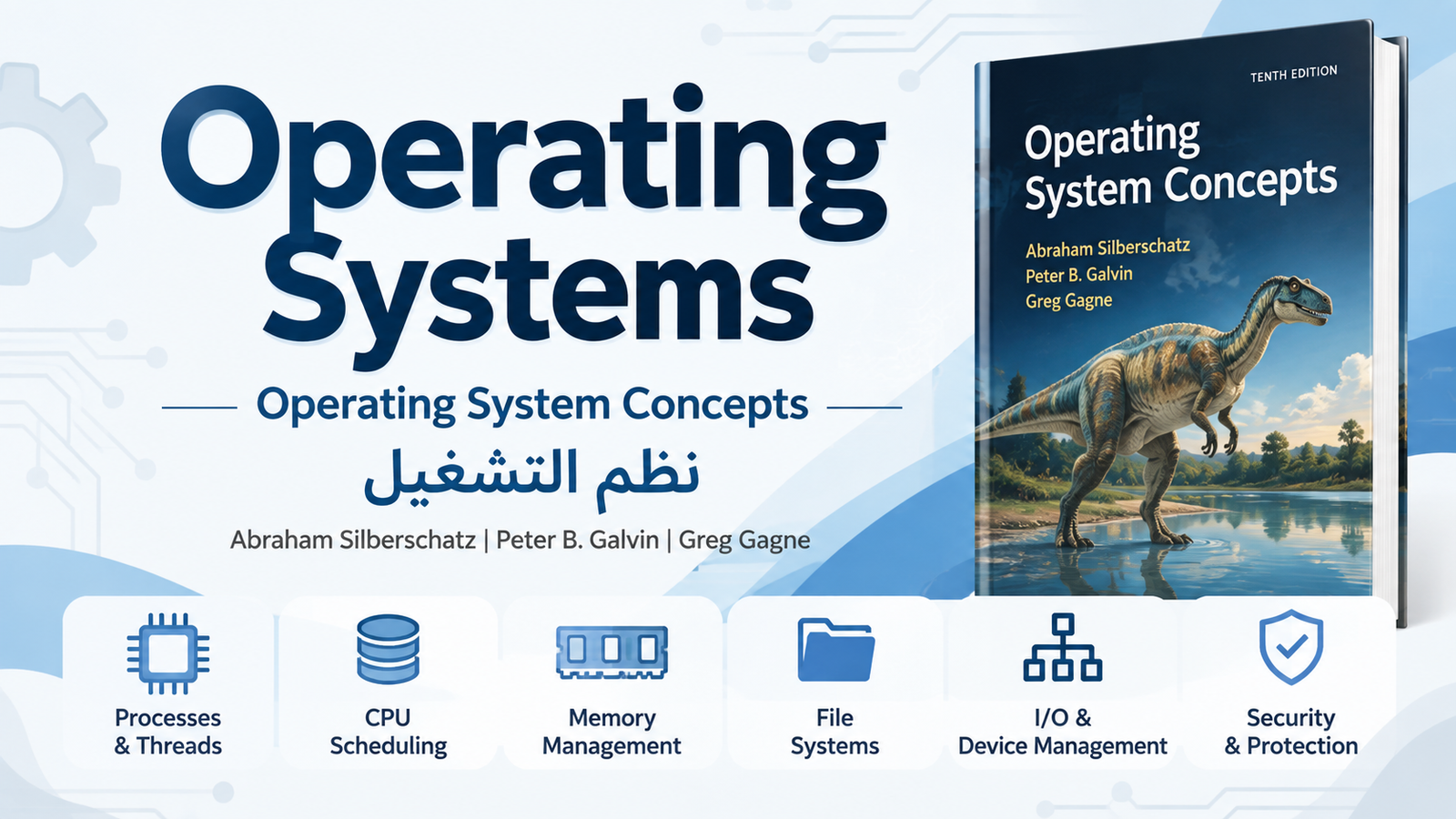
الشرح مبني على الموضوعات الأساسية في كتاب Operating System Concepts للمؤلفين Abraham Silberschatz, Peter B. Galvin, Greg Gagne.
يغطي الكورس موضوعات أساسية مثل: مقدمة في نظم التشغيل، تنظيم وتشغيل نظام الحاسب، هياكل وخدمات نظام التشغيل، العمليات والخيوط، التزامن، جدولة المعالج، الاختناق المتبادل، إدارة الذاكرة، الذاكرة الافتراضية، وأنظمة الملفات.
ملاحظة: قد يختلف ترتيب الفصول أو الأجزاء المطلوبة من جامعة إلى أخرى، لذلك صُمم هذا الكورس كمحتوى عام يمكن الرجوع إليه حسب توصيف كل مقرر.
آراء الطلبة
من تقييمات المشتركين في الكورسات وتعليقات الطلبة على قناة اليوتيوب
الله يسعدك، شرح مفصل ومختصر بنفس الوقت ومفهوم
الله يوفقك ويسعدك، ووالله افهم منك اكثر من الدكتور
ماشاء الله تبارك الله، اول شي الترتيبات جدًا ممتازة في الكورس وكل شي منظم جدا من ناحية الشرح او المقاطع او التجميعات، والله يعطيك العافية يا استاذ عماد، الاشتراك في الكورس ماهو خسارة بالعكس شي كبير وتضمن درجة عالية زي ما ضمنت انا درجة
شكرا بجد، الكلام ده اتشرح في محاضرة 3 ساعات ومفهمتوش، بس في دقايق حضرتك فهمتهولي
محتوى الكورس
Chapter 1 Introduction
- 12:20
What Operating Systems Do
08:54- 03:31
- 07:34
- 12:24
2. Computer System Organization (c) Interrupts
11:08- 05:28
- 09:30
2. Computer System Organization (g) Direct Memory Access (DMA)
09:31Computer-System Architecture
07:36Computer-System Architecture: Clustered Systems
07:47- 13:21
- 06:13
- 07:38
4. Operating-System Operations (c) Timer
05:07- 12:12
Process Management Activities
05:15- 05:09
- 09:07
- 11:16
- 05:28
- 04:23
8. Security and Protection
04:41Kernel Data Structures
11:38Computing Environments and Open-Source Operating Systems
26:099. (a) Emulation (شرح إضافي اختياري)
07:019. (b) Virtualization (شرح إضافي اختياري)
11:44- 04:51
Migration of data “A” from Disk to Register
08:46تحميل ملخص الشابتر pdf
00:00
Chapter 2 Operating-System Structures
1. Operating-System Services
08:452. User and Operating-System Interface
06:563 System Calls (a) System Call
15:553 System Calls (b) System Calls Parameter Passing
08:574. Types of System Calls (a) Types of System Calls
13:144. Types of System Calls (b) Example Standard C Library
05:505. System Programs
06:406. Operating-System Debugging
07:337. System Boot
05:458. Operating-System Structure
10:05تحميل ملخص الشابتر pdf
00:00
Chapter 3 Processes
1. Process Concept (a) Process Concept and Memory
11:051. Process Concept (b) Process State
05:371. Process Concept (c) Process Control Block (PCB)
06:451. Process Concept (d) CPU Switch from Process to Process
07:122. Process Scheduling (a) Scheduling Queues
11:132. Process Scheduling (b) Schedulers
13:413. Operations on Processes (a) Process Creation
12:333. Operations on Processes (b) Process Termination
06:273. Operations on Processes (c) Examples
19:324. Inter-process Communication (a) Independent process vs Cooperating Processes
05:424. Inter-process Communication (b) Shared Memory
10:554. Inter-process Communication (c) Message Passing 1. Direct and Indirect Communication
06:464. Inter-process Communication (c) Message Passing 2. Blocking and Non-Blocking Communication
05:374. Inter-process Communication (c) Message Passing 3. Buffering
06:315. Communication in Client–Server Systems (a) Sockets
12:435. Communication in Client–Server Systems (b) Remote Procedure Calls (RPC)
08:305. Communication in Client–Server Systems (c) Pipes
10:32تحميل ملخص الشابتر pdf
00:00
Chapter 4 Threads
1. Overview
15:462. Multicore Programming
16:403. Multithreading Models
10:024. Thread Libraries
07:31تحميل ملخص الشابتر pdf
00:00
Chapter 5 Process Synchronization
1. Background – Introduction and Producer-Consumer Problem
18:091. Background – Producer-Consumer with Counter
24:471. Background – Race Condition (Producer Consumer Problem) (شرح مختصر)
18:582. Race Condition and the Critical-Section Problem
17:092. The Critical-Section Problem (شرح مختصر)
18:253. Peterson Solution (Software Solution)
21:003. Peterson’s Solution (شرح مختصر)
13:414. Synchronization Hardware (a) Test-and-Set Instruction
23:134. Synchronization Hardware (b) Swap Instruction
11:434. Synchronization Hardware (c) Test-and-Set with n Processes
19:154. Synchronization Hardware (شرح مختصر)
11:155. Mutex Locks
07:196. Semaphores
07:357. Deadlock and Starvation
05:578. Readers-Writers Problem
30:24تحميل ملخص الشابتر pdf
00:00
Chapter 6 CPU Scheduling
6.1 Basic Concept
17:016.2 Scheduling Criteria
07:196.3 Scheduling Algorithms (a) First- Come, First-Served (FCFS)
15:226.3 Scheduling Algorithms (a) FCFS – Example 03
11:456.3 Scheduling Algorithms (a) FCFS – Example 04
07:486.3 Scheduling Algorithms (b) Shortest-Job-First (SJF)
17:546.3 Scheduling Algorithms (b) SJF – Introduction and Examples 01-04
22:086.3 Scheduling Algorithms (b) SJF – Examples 05-06
13:426.3 Scheduling Algorithms (b) SRTF – Explanation and Examples 01-04
18:346.3 Scheduling Algorithms (b) SRTF – Example 05
12:466.3 Scheduling Algorithms (b) SRTF – Example 06
10:476.3 Scheduling Algorithms (c) Priority Scheduling
14:516.3 Scheduling Algorithms (c) Priority Scheduling – Explanation and Examples 01-03
22:226.3 Scheduling Algorithms (d) Round Robin (RR)
16:446.3 Scheduling Algorithms (e) Multilevel Queue
10:14- 18:32
تحميل ملخص الشابتر pdf
00:00
Chapter 7 Deadlocks
7.1 System Model
08:377.2 Deadlock Characterization (a) Necessary Conditions
11:197.2 Deadlock Characterization (b Resource-Allocation Graph)
12:437.3 Methods for Handling Deadlocks
05:467.4 Deadlock Prevention
14:567.5 Deadlock Avoidance (a) Safe State
03:237.5 Deadlock Avoidance (b) Resource-Allocation Graph Algorithm
07:13(7.5) 1 Deadlock Avoidance (c) Banker’s Algorithm part
24:51(7.5) 2 Deadlock Avoidance (c) Banker’s Algorithm part
19:517.6 Deadlock Detection (a) Single Instance of Each Resource Type
09:287.6 Deadlock Detection (b) Several Instances of a Resource Type
15:297.7 Recovery from Deadlock
06:59
Chapter 8 Main Memory
8.1 Background (a) Basic Hardware
10:028.1 Background (b) Address Binding
04:298.1 Background (c) Logical Vs Physical Address Space
10:108.1 Background (d) Dynamic Loading
07:528.1 Background (e) Dynamic Linking and Shared Libraries
10:218.2 Swapping (PSU)
16:478.3 Contiguous Memory Allocation (a) Memory Protection
07:008.3 Contiguous Memory Allocation (b) Memory Allocation
06:048.3 Examples on (First Fit – Best Fit) Algorithms (b) Memory Allocation
07:448.3 Contiguous Memory Allocation (c) Fragmentation
05:528.4 Segmentation (PSU)
29:168.4 Paging (d) Page Table
20:398.4 Paging (b) Implementation of Page Table
16:058.4 Paging (c) Memory Protection
07:588.4 Paging (d) Page Sharing
11:338.6 Paging Example 1
02:118.6 Paging Example 2
02:46ملخص الشابتر pdf
Chapter 9 Virtual Memory
9.1 Background
18:009.2 Demand Paging
12:359.3 Copy-on-Write
08:009.4 Page Replacement
16:559.4 Page Replacement (a) First-In-First-Out (FIFO) Algorithm
14:459.4 Page Replacement (b) Optimal Page Replacement Algorithm
11:179.4 Page Replacement (c) Least Recently Used (LRU) Algorithm
Chapter 10 File-System Interface
1. File Concept مفهوم الملف
16:442. Access Methods طرق الوصول
18:423. Directory and Disk Structure بنية المجلد والقرص
25:364. File-System Mounting تركيب نظام الملفات
07:295. File Sharing مشاركة الملفات
10:016. Protection الحماية
13:30
شرح و حلول الواجبات
تجميعات كويزات
quiz 1 on Chapter 1
09:51quiz 1 on Chapter 3
11:29quiz 1 on chapter [1 – 2 – 3]
10:05quiz 2 on chapter [1 – 2 – 3]
16:14quiz 1 on Chapter 4
15:46
Midterm 1
Question 3 (a) FCFS
03:47Question 3 (b) Round Robin (RR)
10:13
Midterm 2
Midterm 2 Question 3-(a) Shortest-Job First (SJF)
12:23Midterm 2 Question 3-(b) Round Robin (RR)
08:14
Midterm Fall 2017
Question 1 [MCQ questions ]
04:15Question 2 [True/False]
05:37
Midterm first term 2023
Question 3 – (a) []
04:33Question 3 – (B)
01:27Question 3 – (C)
02:04Question 3 – (D)
06:43Question 3 – (E)
04:46
Final Term Exam, Fall 2021, 42-43
Question 1 – (a) [MCQ ]
05:25Question 2 (c-d) 1. FCFS
05:42Question 2 (c-d) 2. Non-preemptive SJF
06:08Question 2 (c-d) 3. Preemptive priority
08:02Question 3 (a) What is critical section problem List the three necessary conditions for critical problem solution.]
01:21Question 3 (b) [Let S and Q be two semaphores initialized to 1. What is wrong with following scenario? Explain your answer.]
03:36Question 4 (a) [What is the difference between internal and external fragmentations?]
01:17Question 4 (b) [On a system using First fit algorithm for memory allocation, assume the memory was allocated as specified in the figure below. The figure shows 5 processes occupying blocks of sizes 10k, 20k, 10k, 30k, 10k, respectively)]
07:44
Final Term Exam, Spring 2022, 42-43 تقنية المعلومات
Question 4 (a) [Q4-1: Given five memory partitions of 150 Kb, 450 Kb, 220 Kb, 300 Kb, and 550 Kb (in order), how would the first-fit, best-fit, and worst-fit algorithms place processes of 250 Kb, 450 Kb, and 100 Kb and 500Kb (in order).]
07:34Question 4 (b) [Q4-2: Show if the graph stated below has a deadlock or not? Why? ]
06:50Question 4 (c) [Q4-3: Suppose that both of processes P1 and P2 concurrently read the value stored in a memory location X, then add 10 to it and assign it back to X (shared resource). State the type of this process communication problem]
05:30
Final Exam Fall 2024, 1446
Question 1 (MCQ)
06:42Question 2 (a) – (i) FCFS Scheduling
08:31Question 2 (a) – (ii) SJF Scheduling
16:19Question 2 (a) – (iii) Priority Scheduling
12:37Question 3-(a)
01:21Question 3-(b)
03:36Question 4-(a)
19:06Question 4-(b)
04:28
Operating Systems Midterms Chapters 1, 2, 3 Dr. Sarah Al-Raddadi
Operating Systems Midterm – Quiz 1 | Chapters 1, 2, 3
Operating Systems Midterm – Quiz 2 | Chapters 1, 2, 3
Operating Systems Midterm – Quiz 3 | Chapters 1, 2, 3